
CLEAR PRODUCT INFORMATION
CLP Chemical Hazard Labels
Custom-printed CLP labels for chemical products and hazardous mixtures. Supply your approved artwork containing the required product information, hazard pictograms and safety wording, and we will print it in your chosen size and material.
Your selected size, material, quantity and price continue with you.
Upload your print-ready file
PDF, PNG, JPG, GIF, DOC, DOCX, PPT or PPTX · maximum 20MB · 300+ DPI recommended.
 ★★★★★Read customer reviews on Trustpilot ↗
 ★★★★★Read verified Google reviews ↗
About our clp chemical hazard labels
Order custom CLP labels for chemical substances, hazardous mixtures, cleaning products, fragrances and other products requiring clear hazard information. We print from your supplied and approved artwork, giving you control over the product details, pictograms, warnings and precautionary wording shown on each label.
Labels can be produced in a range of shapes, sizes and materials, including paper labels on rolls and durable vinyl labels on sheets. We can also quote for specialist materials when a standard paper or vinyl label is not suitable.
What is a CLP label?
CLP stands for Classification, Labelling and Packaging. The system is used to classify chemical substances and mixtures and communicate their hazards through standardised label information, wording and pictograms.
The GB CLP Regulation applies to relevant substances and mixtures placed on the market in England, Scotland and Wales. Products placed on the Northern Ireland market are subject to EU CLP rules. Businesses should always check the latest requirements for the market in which their product will be supplied.
What information might a CLP label contain?
Depending on the product, its classification and where it will be supplied, CLP label elements may include:
- The product identifier or product name
- Supplier name, address and telephone number
- Nominal quantity where applicable
- One or more hazard pictograms
- A signal word such as “Danger” or “Warning”
- Hazard statements
- Precautionary statements
- Supplemental information where required
- Other market-specific information
Not every product requires every element, and the exact content depends on its classification and applicable legislation. The information should be taken from a competent regulatory source, an up-to-date Safety Data Sheet or a suitably qualified chemical compliance adviser.
We print your approved information
StickyLabels provides a label printing service. We do not classify chemical products, select hazard statements or decide which pictograms and legal information your label requires.
You are responsible for supplying complete and legally accurate artwork and for checking that the finished design meets the rules applying to your product and target market. We check artwork for practical printing issues such as image quality, positioning, bleed and cutting, but this is not a regulatory compliance check.
CLP hazard pictograms
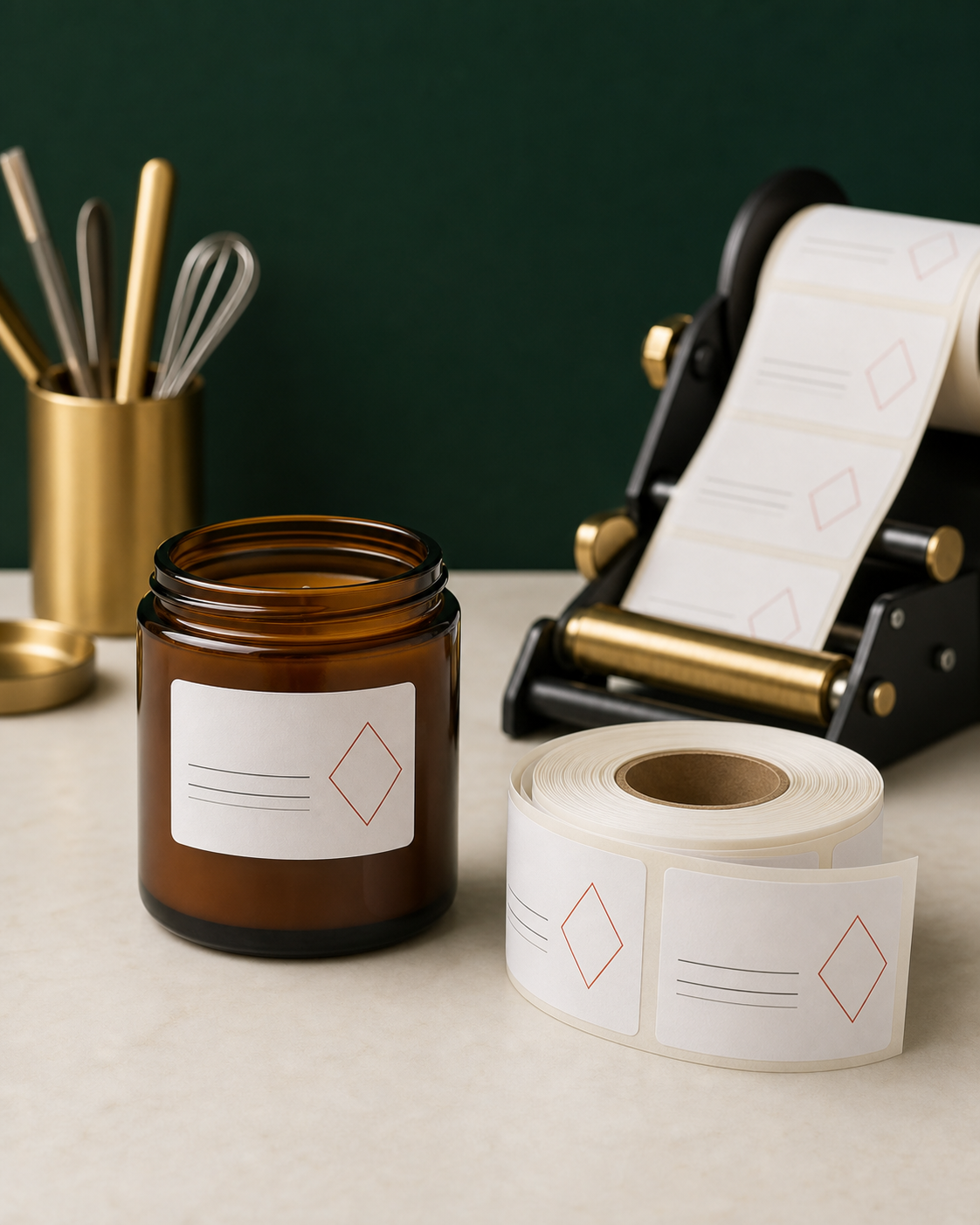
CLP hazard pictograms use a black symbol on a white background within a red diamond-shaped border. Where pictograms are required, they must remain clear, correctly proportioned and large enough for the relevant package.
For this reason, a black-only Discount Label should not be used for artwork requiring red-bordered CLP pictograms. Choose a full-colour Custom Label, Custom Vinyl Label or another suitable full-colour option instead.
Please supply official, high-quality pictogram artwork rather than copying low-resolution symbols from a website or document. Vector artwork is recommended because it remains sharp when resized.
Choose the right CLP label material
The material should be selected according to the container, storage conditions, product contents and expected handling.
- White paper – suitable for general dry indoor applications where the label will not encounter moisture or chemicals.
- Gloss-laminated paper – provides a bright finish and additional protection against moisture, scuffing and handling.
- Matt-laminated paper – offers a low-shine appearance with additional protection for the printed surface.
- Gloss white vinyl – a durable sheet material with a bright full-colour finish.
- Matt white vinyl – a durable, low-shine sheet material for a clear professional appearance.
- Gloss clear vinyl – suitable for selected transparent applications, provided all mandatory information and pictograms remain clearly visible.
- Extra-thick, extra-sticky vinyl – intended for more demanding surfaces where a heavier material and stronger adhesive are needed.
- Specialist materials – available for applications requiring a more specific label construction or security feature.
Chemical resistance must be tested
No label material should be assumed to resist every chemical, solvent or cleaning process. Water resistance does not automatically mean resistance to alcohol, acetone, oils or other aggressive substances.
If the label could come into direct contact with its contents, cleaning chemicals, repeated abrasion, refrigeration or outdoor weather, ask us for a sample before ordering. Test the complete label—including the print, surface finish and adhesive—on the actual container under realistic conditions.
Choosing the correct label size
Your label must be large enough for the required information to remain legible and for hazard pictograms to be reproduced correctly. The applicable minimum label and pictogram dimensions can depend on the capacity of the packaging and the rules governing the product.
Choose from our preset rectangular sizes or select another shape and size suitable for your container. Check the current legal requirements before reducing text or pictograms to fit a small label.
Artwork requirements for CLP labels
For the best print quality, supply your complete label as a vector PDF, AI or EPS file. We can also print from a high-resolution JPEG or PNG supplied at 300dpi at the finished label size.
- Include 2–3mm bleed if the background prints to the edge.
- Keep mandatory wording and symbols safely inside the cutting line.
- Use clear, legible text at an appropriate finished size.
- Supply hazard pictograms as sharp vector graphics wherever possible.
- Make sure the red pictogram borders and white backgrounds are present.
- Check that all codes, statements and supplier details are correct.
- Confirm that the artwork is suitable for the country in which the product will be sold.
We provide a PDF proof where required and only print after the artwork has been approved.
Labels for different chemical products
Custom chemical hazard labels may be used for:
- Cleaning and maintenance products
- Industrial chemicals and mixtures
- Fragrance oils and home-fragrance products
- Automotive fluids and treatments
- Paints, coatings, adhesives and sealants
- Laboratory and manufacturing products
- Garden and agricultural chemicals
- Refilled, repackaged or own-brand chemical products
Different product groups may also be covered by additional legislation. CLP printing alone does not confirm that a product, package or label meets every applicable requirement.
Tactile warning triangles
Some products supplied to the general public may require a tactile warning of danger on the packaging. A tactile warning is a separate raised feature and is not replaced by printing a triangle or hazard pictogram on the label.
We offer tactile warning triangle labels separately in fixed quantities. It remains the supplier’s responsibility to establish whether one is required and to position it correctly.
Why choose StickyLabels?
- UK label manufacturer established in 1973
- Full-colour printing for CLP pictograms and hazard information
- Paper labels on rolls and vinyl labels on sheets
- Custom shapes and sizes available
- Laminated and specialist material options
- Small and large print quantities
- Artwork checked for print quality
- PDF proof supplied where required
- Fast production and tracked UK delivery options
For current regulatory information, visit the Health and Safety Executive’s guidance on chemical labelling and packaging. If you need help with classification or legal wording, consult a suitably qualified chemical regulatory adviser before submitting your artwork.
Can’t find what you’re looking for? Visit the StickyLabels homepage to explore our complete range of custom labels and stickers.
Supply your approved CLP artwork
Send us your completed label design containing the correct product identifier, supplier details, hazard pictograms, signal word and required statements. We check the artwork for print quality, but the classification, wording and legal compliance must be confirmed by you before printing.
Choose a suitable material
Choose laminated paper for added protection or vinyl for labels that may encounter moisture and frequent handling. For chemicals, solvents or harsh environments, request samples and test the material, print and adhesive against the actual product before placing a full order.
Clear, legible hazard printing
We print supplied CLP label artwork in full colour, including the recognised red-bordered hazard pictograms. Select a size that allows all required information to remain clear and readable on the finished container.
Customer reviews
Independent verified reviews from real Sticky Labels customers.
★★★★★“Excellent service! Great help with design, advice about cost-effective production and amazingly fast delivery.”
Judith Ley
★★★★★“Multiple customer of this amazing print company. Absolutely delighted with the speed and accuracy of their work, as well as sensible prices.”
Eran Bauer
★★★★★“Great company. Responsive, accurate and reasonable. Have been using them for several years.”
Diana Clark
★★★★★“Sticky Labels have been my label provider for the last 12 years. The team offer fast and efficient service.”
Deborah Niven